Waterfall edges, mitred corners and where the seams go
Most of what makes a waterfall island look right is decided on paper, before a saw touches the slab.
September 30, 2026 · 3 min read
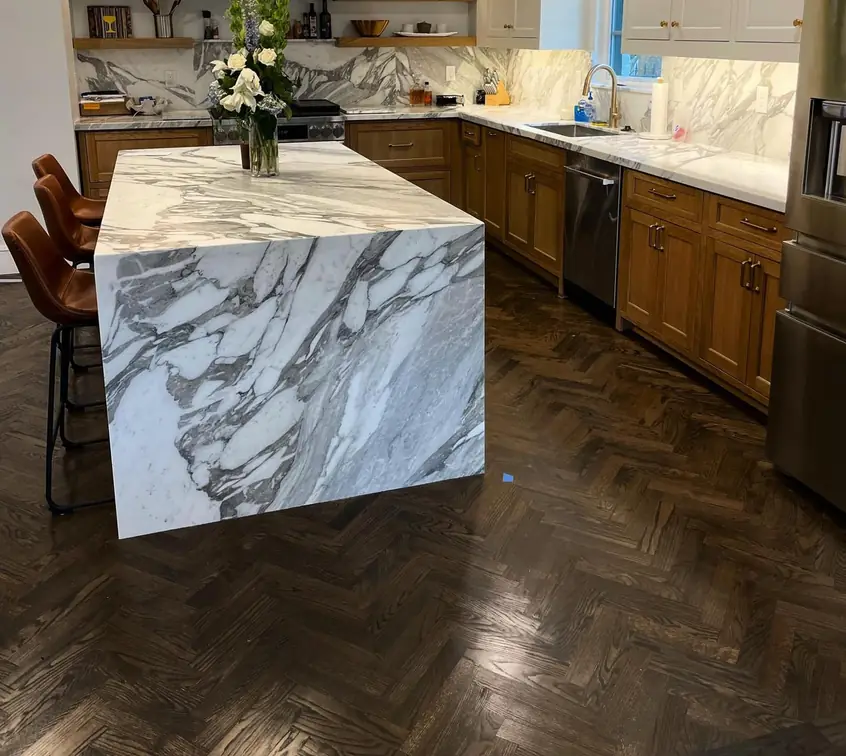
A waterfall edge is what happens when the countertop does not stop at the edge of the island. The stone carries on down the side, all the way to the floor, so the end of the cabinet is covered in the same slab as the top. Done well, it makes an island look like one solid block. Done carelessly, it shows a hard line and a jump in the pattern. Most of the difference is settled on paper, before any stone is cut.
What a mitred corner is
There are two ways to join the top to the side. A butt joint simply sets the vertical piece against the underside of the top, and you see the thickness of the stone at the corner. A mitre cuts both pieces at forty-five degrees so they meet in a clean diagonal, and the corner reads as a single bend in the stone rather than two pieces meeting. The mitre is the joint most people picture when they say waterfall.
It is exacting work. Both cuts have to be perfectly straight, the pieces are bonded together, usually with an adhesive tinted to the stone, and the joint is polished flat. A small gap or a slight difference in height is easy to see on a long, hard edge, which is why a waterfall island is a fair test of a fabricator's skill. The panel is also heavy stone standing on edge, so the cabinet end beneath it has to be square and solid.
Matching the veining across the fold
Vein matching is what makes a waterfall look like a single piece of stone rather than several. The fabricator cuts the top and the side from the same part of the slab, so that a vein running across the top continues down the leg. Usually that means extra length of slab is needed to make the fold line up, and a slab with a strong, directional pattern asks for more care than a quiet, even one.
Some islands go further and use a bookmatch: two consecutive slabs from the same block are opened like a book, so the pattern mirrors itself down the centre. It is dramatic on natural stone with bold veining, and it only works when the slabs came out of the block side by side. Ask whether the slabs you are looking at were cut consecutively, and whether the island needs one waterfall end or two.
Why seam placement is a layout decision
Slabs come in a limited size. A long island, or one with a return on the end, often needs more than one piece of stone, and where the pieces meet is the seam. It cannot be avoided by wishing, but it can be placed well.
Seams are usually kept away from the cut-outs for the sink and the cooktop, because the narrow strips of stone left beside a cut-out are the weakest part of a top. They are also placed where the pattern gives them cover, or at a natural break such as a corner. Cabinet layout matters too, since a seam needs solid support underneath. This is why a fabricator makes decisions about seams while drawing the layout, not on install day.
What to ask to see before anything is cut
- A layout drawing that marks every seam, with the position of the sink and cooktop cut-outs shown on the same sketch.
- The actual slab, or a photo of it laid out, with the direction of the veining and the way it will run across the fold.
- Which parts of the slab will become the top, the side panel and any backsplash, so the pattern can be judged before it is committed.
- How the mitred corner will be joined and finished.
A shop that has done this before will not mind the questions. Approving the layout is the last easy moment to change your mind, so it is worth taking your time over it. If the drawing shows a seam somewhere that bothers you, say so then. Moving a line on paper costs nothing, and moving it after the slab is cut usually means starting again with new stone.
Emcar Stone Studio does countertop fabrication and installation for kitchens and bathrooms across Northwest Arkansas, and it offers free estimates. What a waterfall island costs depends on the slab and the layout, since a second slab or a bookmatched pair changes the amount of material needed.
To talk through an island, visit the showroom at 142 N Maestri Rd, Springdale, any weekday from 8:00 AM to 4:00 PM, or call (479) 977-6259.
Emcar Stone Studio, (479) 977-6259
Call (479) 977-6259More articles
Quartz and quartzite share a name and very little else
One is manufactured and one is quarried, and the difference shows up in how each counter looks, ages and gets cared for.
Living with marble in a kitchen that actually gets used
Marble rewards the owner who knows what to expect from it and frustrates the one who does not.