Quartz and quartzite share a name and very little else
One is manufactured and one is quarried, and the difference shows up in how each counter looks, ages and gets cared for.
September 30, 2026 · 3 min read
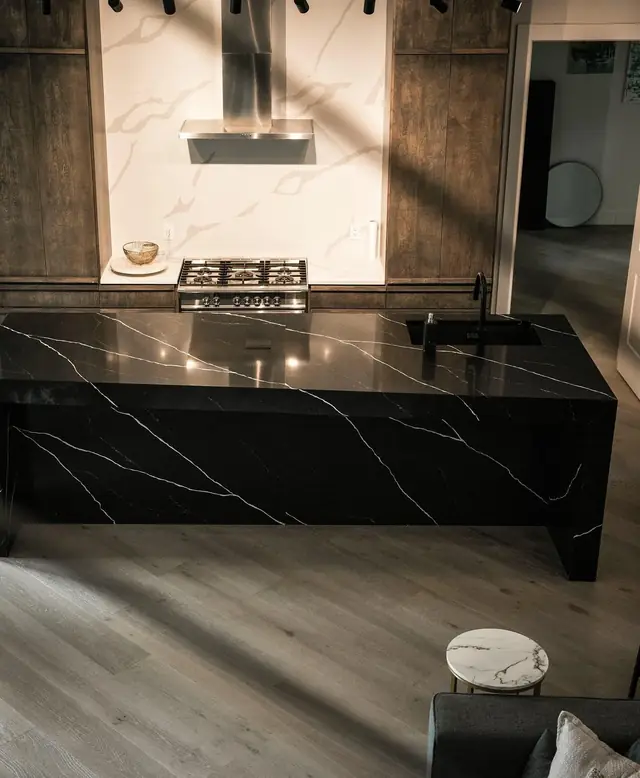
Quartz and quartzite sound like the same product with a spelling difference. They are not. One is a manufactured surface and the other is stone that was quarried, and the two behave differently on a kitchen counter. Getting the names straight before you shop saves a lot of confusion once you are standing in front of a rack of slabs.
Where each one comes from
Quartz counters are engineered. A manufacturer grinds natural quartz crystal into fine aggregate, binds it with resin and pigment, and presses the mixture into a flat slab. Because the recipe is controlled, the colour and pattern are designed on purpose. That is how you get a very even white, a soft grey with faint movement, or a deep black with bold white veining, and it is how one slab can be matched to the next in the same run.
Quartzite is natural. It began as sandstone, and heat and pressure over a very long time fused the sand grains into a dense, hard rock. Each slab is cut from a quarried block, so the pattern is whatever the earth produced: soft clouds of grey, pale streaks of gold, blue-grey rivers. No two slabs are identical, and nobody can reorder the veining to suit your plans.
How they behave day to day
Engineered quartz is generally non-porous, because the resin fills the space between the particles. That is why most owners find it undemanding. It is normally sold as a surface that does not need sealing, and it tends to shrug off coffee and wine. The resin is also the trade-off. It can be marked by strong solvents and by a very hot pan set straight onto the surface, so a trivet is a sensible habit.
Quartzite is usually harder than people expect, and it does not react to heat the way resin can. It is still natural stone with pores, though, and some slabs are more absorbent than others. Many fabricators recommend sealing it. A simple test is worth doing on any slab you like: put a few drops of water on an offcut of the same stone and see how quickly it darkens and how long it takes to fade.
A word of caution about the name
The trade uses the word quartzite loosely. Now and then a stone sold under that name turns out to be softer than it looks, closer to marble, and it will etch when acid touches it. True quartzite does not do that. This is the main reason to test an offcut rather than trusting a label, and to ask the person selling the slab exactly what it is and where it came from.
How to tell which one is in front of you
No single check is perfect, but a few things point in the right direction.
- Pattern: engineered slabs come from a controlled mix, so the veining can look slightly too regular or repeat from slab to slab. Natural stone varies more, and the flow of the veining usually feels less tidy.
- Surface: natural quartzite often shows tiny crystals that catch the light with a glassy sparkle. Quartz shows an even speckle of small particles set in a uniform base.
- Water: on an offcut or an unfinished edge, a drop of water tends to sink into natural stone slowly and sit on top of engineered quartz.
- Ask: the person selling the slab should be able to say which one it is without hedging.
Choosing between them
Quartz suits people who want predictable colour, a pattern that can match across a long run of counters, and a routine with very little upkeep. Quartzite suits people who want the character of natural stone and a surface that is comfortable with hot cookware, and who do not mind a sealing routine. Neither is better in the abstract. The right one fits how you cook, how much maintenance you will really do, and what you see when you hold a sample against your cabinets.
Emcar Stone Studio sells both, along with granite, marble, porcelain and soapstone, so anyone in Northwest Arkansas can compare the options with a single shop. What either one costs depends on the slab and the layout, and the way to find out is a free estimate.
The showroom is at 142 N Maestri Rd in Springdale, open Monday to Friday from 8:00 AM to 4:00 PM. Call (479) 977-6259 to talk through materials or to ask for a free estimate.
Emcar Stone Studio, (479) 977-6259
Call (479) 977-6259More articles
Living with marble in a kitchen that actually gets used
Marble rewards the owner who knows what to expect from it and frustrates the one who does not.
Soapstone counters and the way they age
A soft charcoal stone that records the life of a kitchen and can be renewed with a sheet of sandpaper.